
| Black Dhoop |

|
 |

|


 |
 ative ative |
 |
 |
 |
Photo: |
Botanical name: Canarium strictum Family: Burseraceae (Torchwood family)
Synonyms: Rumphia amboinensis, Pimela stricta
Synonyms: Rumphia amboinensis, Pimela stricta
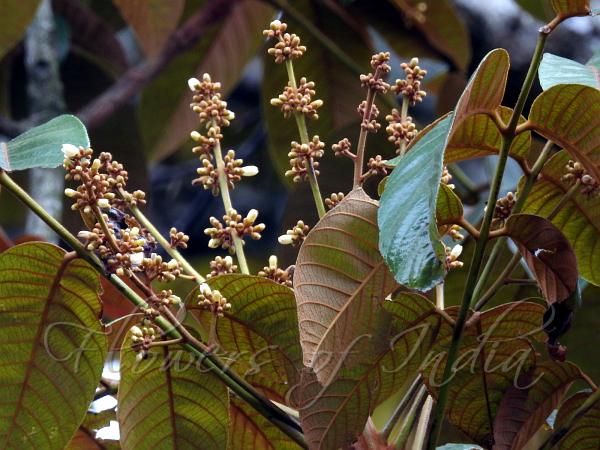
Black Dhoop is a large tree with a spherical crown,
having a clean bole of 30-35 meters in length. Leaves are compound,
imparipinnate, alternate, spiral, clustered at twig ends, axis is
ferruginous velvet-hairy; leaflets 3-9 pair with odd one at tip,
increasing in size towards tip; leaflet-stalk is 0.3-0.7 cm long,
Leaflets are 5-15 x 2.5-7 cm, usually oblong, sometimes ovate, tip
tapering, base asymmetric-rounded; margin sawtoothed or minutely
toothed, leathery, rusty woolly or velvet-hairy beneath and hairless
above; secondary nerves are strong with 11-18 pairs; tertiary nerves
are weakly percurrent. Flowers are bisexual or polygamous, in shortly
branched in leaf-axil panicles, about 1 cm long, yellow to dull white,
shortly stalked and mildly fragrant. Male flowers about 7 mm, female
flowers about 9 mm. Petals below nearly hairless to densely woolly.
Stamens hairless; filaments fused for 1/4-3/4 of length; anthers
tapering. Sepal-cup is nearly hairless or rusty woolly below, with
short blunt sepals, about 4 mm in male flowers, about 5.5 mm in female.
Fruits are 2.5-5.0 cm long, pointed at ends, mesocarp fleshy, stone
hard, aromatic and seeds trigonous, usually 3-celled with three seeds.
The resin of the tree is used in making incense sticks.
Black Dhoop is native to S. India, Sikkim to China (S. Yunnan) and N.
Thailand. Flowering: February-April.
Medicinal uses: The species is rich sources
for Sambrani which is used to cure various bronchial
ailments. The resin powder is given orally to cure rheumatism, fever,
cough, asthma, epilepsy,
chronic skin disorders, syphilis, and hernia and also helps to improve
complexion. Five grams of powdered stem resin is burnt and the smoke
is inhaled (vapour bath) at the time of headache. This practice relieves
cold when it is administrated for two times a day for three to four days.
The species is rich sources
for Sambrani which is used to cure various bronchial
ailments. The resin powder is given orally to cure rheumatism, fever,
cough, asthma, epilepsy,
chronic skin disorders, syphilis, and hernia and also helps to improve
complexion. Five grams of powdered stem resin is burnt and the smoke
is inhaled (vapour bath) at the time of headache. This practice relieves
cold when it is administrated for two times a day for three to four days.
Medicinal uses:
The species is rich sources
for Sambrani which is used to cure various bronchial
ailments. The resin powder is given orally to cure rheumatism, fever,
cough, asthma, epilepsy,
chronic skin disorders, syphilis, and hernia and also helps to improve
complexion. Five grams of powdered stem resin is burnt and the smoke
is inhaled (vapour bath) at the time of headache. This practice relieves
cold when it is administrated for two times a day for three to four days. | Identification credit: Srinivasan Kasinathan | Photographed in Coimbatore distt, Tamil Nadu & FRLHT & Sakleshpur, Karnataka. |
• Is this flower misidentified? If yes,